What is a phylogenetic network?
The classical mathematical model to represent evolution (of some species, or genes) is
the phylogenetic tree. But trees are unable to represent horizontal gene transfer,
recombination or hybridization events: in those cases, some branches of the tree
combine into a reticulation node, and the tree becomes a network.
The main question about phylogenetic networks is how to
reconstruct them from
available data. This data can be of different kinds:
sequences
(sometimes binary sequences),
distances
between those sequences,
rooted or
unrooted trees,
triplets
(rooted trees on three leaves),
quartets
(unrooted trees on four leaves),
splits
(bipartitions of the set of leaves),
clusters
(subset of leaves which should appear together
in the network),
multilabeled trees
(in the context of duplications),
or even
networks
(to get a consensus network from the input).
This question gave rise to some other ones: how to
visualize
phylogenetic networks (which is linked with graph drawing, except in phylogeny the lengths
of the branches may be constrained), or how to
compare
them in the context of
evaluation
of the reconstruction methods.
These problematics give rise to many theoretical problems,
some of which are
polynomial,
but many of which are
NP-complete.
Fixed-parameter tractable,
approximation algorithms,
or
heuristics
have thus been developed to solve them.
Depending on the problem adressed, and its complexity, the network used in the analysis may be
an
explicit phylogenetic network if it describes biological events,
or an
abstract phylogenetic network if its edges may not be interpreted biologically.
A popular example of abstract network in the literature is the
split network
which can be used as a visualization of a set of incompatible phylogenetic trees, therefore giving
some understanding on the conflicts present in the data.
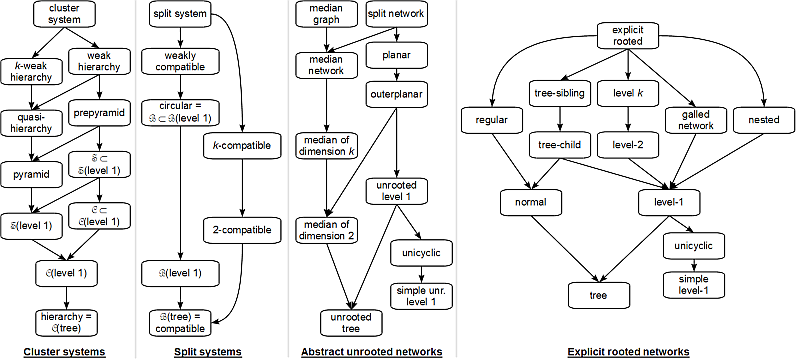
Inclusion of phylogenetic network classes
This
ISGCI-like
hierarchy is under construction...
An arrow pointing from a class A to B represents that A contains B (beware, no arrow doesn't mean that the classes are disjoint, they may overlap!).
Here phylogenetic networks are considered as combinatorial objects
with graph properties, if you want to see a hierarchy which classifies
some existing kinds of networks according to the context in which they are used,
you can refer to Figure 1 in [
HusonBryant2006].
More details about these figures will be available in
my PhD thesis.
More information on these classes of phylogenetic networks:
abstract network,
block realization,
explicit network,
galled-tree,
galled-network,
level-f phylogenetic network,
normal network,
pyramid,
regular network,
reticulogram,
tree-child network,
tree-sibling network,
split network,
unicyclic network,
weak hierarchy,
weakly compatible set of splits...
See also


 Philippe Gambette -
LIGM, office 4B079 +33(0)1.60.95.77.34
Philippe Gambette -
LIGM, office 4B079 +33(0)1.60.95.77.34