Philippe Fraisse

Homepage

  • Increase font size
  • Default font size
  • Decrease font size

Philippe Fraisse Homepage

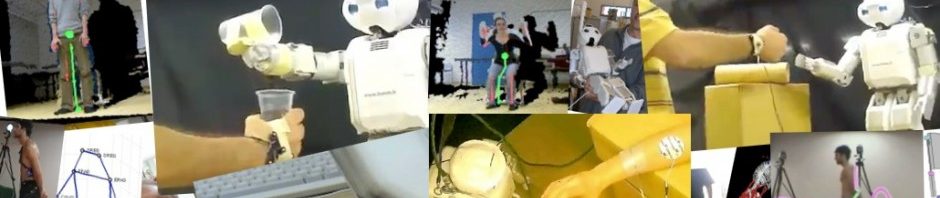
My research interests are focused on modeling and control applied to robotic and rehabilitation fields. My research activities about the robotic fields is mainly dedicated on two-arm and humanoid robot, robust position/force control algorithms for mobile manipulator. I am involved in the DEMAR Project Team in which I am currently working on the muscle control algorithm development dedicated to paraplegic patients. I developed a new concept based on instrumented walker in order to give to patients the control of their lower limbs. The other aspects of my research activities are presented in the IDH Project Team in which I focus my efforts on kinematic modeling, safe motion planning and two-arm control strategy dedicated to Humanoid robot for assistive robotics.

I am also involved in the French Research Group in Robotics as co-leader of the WG7 (Working Group 7: Humanoid Robots). I co-organize the French Workshop on Humanoid Robotics named JNRH (Journées Nationales de la Robotique Humanoïde). See the websites: JNRH'07, JNRH'08, JNRH'09, JNRH'10, JNRH'11.

Keywords: humanoid robots, two arms robots, mobile manipulator, networked robot, teleoperation, rehabilitation robotics, FES, muscle control.


IROS 2011

Interactive Manipulation Between a Human and a Humanoid: When Robots Control Human Arm Motion

see IEEE SPECTRUM

In this paper we present a new approach in human/robot collaboration, where the robot controls not only its arm but also the human’s by means of functional electrical stimulation (FES). The task is described by using the cooperative dual task-space approach, providing a considerable degree of invariance with respect to the morphology of the agents involved. Experimental results in a “ball in the hoop” task using healthy blindfolded subjects show the validity of the approach and encourages further experiments with impaired subjects, for instance hemiplegic or quadriplegic patients.


ICRA 2011

We propose a novel approach for interactive manipulation involving a human and a humanoid. The interaction is represented by means of the relative configuration between the human’s and the robot’s hands. Based on this principle and a set of mathematical tools also proposed in the paper, a large set of tasks can be represented intuitively. We also introduce the concept of simultaneous handling using mirrored movements, where the human controls the robot and simultaneously interacts with it by means of a common manipulated object. Illustrative experiments are performed to validate the proposed techniques.
 

ICARO (2011-2013)

The ICARO project aims the development of tools in order to improve and to simplify the interaction between industrial robots on one side and humans and the environment on the other side. The project also aims to produce tools build around a middleware software architecture securing the interoperability of these tools. ICARO differences from other projects aiming service robots by the implementation of industrial use cases, by the association of research laboratories and SMEs ready to commercialize the project's results, by the importance granted to the safety standards and by the participation of an ergonomy team in order to deal throughout the project with the human aspects. ICARO will produce: - tools for intuitive robot programming including reactive planning of trajectories through fusion of real and virtual data as well as tools for robot programming through points learned by manual guidance and completed by process knowledge - Tools for perception of the environment linked to 3D models allowing faster, richer and more reliable interactions with the environment and the operators - An open source software architecture enabling the interoperability of the tools developed as well as its dissemination. The middleware will be selected on the basis of specific criteria for the industrial applications of the project. It will allow the interface and the transfer towards the industry of new human-robot interaction methods for complex manipulation applications. - A methodology of task attribution among humans and robots based on the physical and cognitive ergonomical analyses as well as production constraints. These activities will also be oriented towards other industrial sectors, SMEs and towards robot constructors, their integrators and the providers of software solutions for robotics.
 

@WALK Project (2010-2012)


@WALK (ArTificial WALKing) is a collaborative project supported by INRIA for researchers and students exchanges between DEMAR Project-Team and the Robotics Lab of Stanford University. French Coordinator: Pr. P. Fraisse (LIRMM), Université Montpellier 2, France, Partner Coordinator: Pr. O. Khatib (Robotics Lab), Stanford University, USA

Scientific goals of the proposal

Overall Objectives

The motivation approach is the complementary research works of these teams. Indeed, a collaborative project should give an additional value to their research results. On one hand, the DEMAR Project Team has experience in Functional Electrical Stimulation to restore or modulate movements on spinal cord injured patients and post stroke patients. In both pathologies researches on assisted gait using FES (for paraplegics with a walker and hemiplegics) are carried out in the team (cf. Figure 1).


:INRIA-AT-DEMAR-STANFORD-v01-Phil_fichiers:image001.png Sans titre2

Figure 1: (a) Paraplegic patient walking under FES, (b) Implanted FES stimulator


Read more...
 
More Articles...
  • «
  •  Start 
  •  Prev 
  •  1 
  •  2 
  •  Next 
  •  End 
  • »


Page 1 of 2

PF2.jpg

Project Teams

IDH
Interactive Digital Human
DEMAR
Artificial Walking project