







ARTHEMIS Team
hARdware THreat Evaluation and Mitigation for Integrated Systems
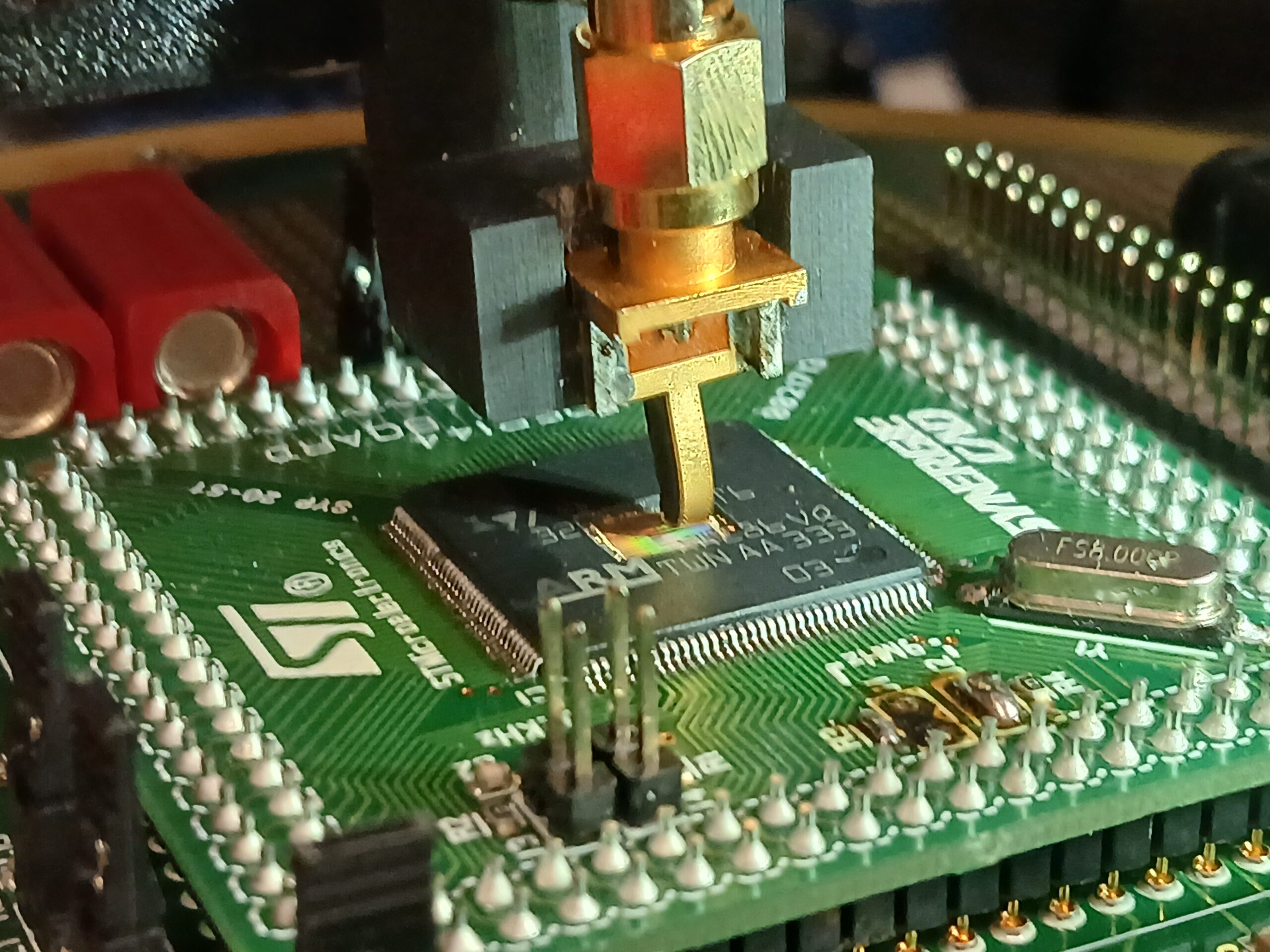
The ARTHEMIS team is a team of around fifteen researchers (six permanent staff) whose activities focus on hardware security and the implementation of secure embedded systems. Improving the reliability and security of these devices is at the heart of our concerns. This involves, among other things, exploring or researching new attack vectors and defining appropriate protections, whether hardware, software, or mathematical.
The ARTHEMIS team is characterized by its desire to conduct research from theoretical concepts to the development of demonstrators evaluated in realistic application contexts. It publishes in journals and conferences specific to security (CRYPTO, CHES, CASCADE, HOST, etc.) and to the design of integrated systems (IEEE trans. On CAD/VLSI/Computers, DATE, etc.).
The team’s activities are organized around the following two areas:
The team’s activities are organized around the following two areas:
Axis 1 : Anticipating and controlling threats
Physical attacks are becoming increasingly effective. In particular, the emergence of machine learning techniques (neural networks) in the field of side-channel attacks is, in some cases, calling into question the effectiveness of countermeasures that were previously considered robust.
Similarly, electromagnetic channel leaks, whose complexity and diversity remain poorly understood (RF channels, TEMPEST, covert channels), represent a constant source of new threats to integrated circuits and systems. Furthermore, fault injection methods are a persistent and constantly evolving threat, marked by the regular emergence of new techniques (EMFI, BBI, Xray, FI, etc.).
In this context, the team is working to master these tools in order to identify their potential and limitations.
Axis 2 : Secure implementations
With its in-depth knowledge of hardware attacks, both theoretical and practical, the team offers security solutions tailored to the embedded world. This involves developing new protections and optimizing existing solutions in order to secure the implementation of new technologies (such as blockchain), protocols, and pre- and post-quantum algorithms (code-based encryption, Euclidean networks, etc.) at a lower cost. On this last point, our approach consists of designing and testing decentralized trust and reputation mechanisms specially adapted to the constraints of the IoT.
Regardless of the security solutions adopted when designing an integrated system, another major challenge lies in verifying the correct implementation of these countermeasures before manufacturing. This challenge is all the more crucial given that current CAD tools offer little or no means of identifying residual information leaks prior to manufacturing, or of simulating the impact and propagation of intentionally injected faults. This issue is one of the team’s areas of focus.
Permanents
- Florent Bruguier (MCF – HDR)
- Loïc Demange (MCF)
- Jean Marc Gallière (MCF)
- Loïc Masure (CR)
- Philippe Maurine (PR)
- Thibault Vayssade (MCF)
Doctorants
- Jean Nicaise Akaffou
- Jeremy Dron
- Ziling Liao
- Anselme Mouette
- Abdoul Ndiaye
- Thibault Penning
- Nathan Rousselot
- Sara Sahraee
- Malek Sfaxi