


Robust and adaptive controllers for underwater vehicles 

Experimental testbed

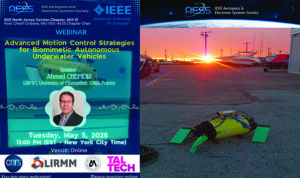
We study the design of adaptive and robust controllers for underwater vehicles. All of our results are experimentally validated on a modified version of the AC-ROV (AC-CESS Ltd).


The AC-ROV submarine is an underactuated vehicle, the propulsion system of which consists of six thrusters driven by DC motors controlling five degrees of freedom. The robot weighs 3kg and has a rectangular shape with height 203mm, length 152mm and width 146mm. For measurements purposes, our prototype is equipped with various sensors. A 6 DOF IMU (Inertial Measurement Unit) measures roll, pitch, and yaw and a pressure sensor allows depth measurement.


Adaptive control

Recently we have completed a study and experimental comparison of existing control laws (PID, Adaptive non linear state feedback), especially regarding their robustness towards uncertainties (parametric) and disturbances (shock, waves…).

Currently, our work is focused on the implementation of the L1 adaptive controller. This controller, well known for its fast adaptation and its robustness, is for the first time applied in the field of underwater vehicle control. The various scenarios that we have tested, have demonstrated the ability of the L1adaptive law not only to successfully control pitch and depth (even with strong modeling uncertainties), but also to be robust towards disturbances like waves or buoyancy changes.


Video of our latest experimental results.


Team – Full time researchers

Dr Ahmed Chemori (CNRS Researcher)

Dr Frederic Comby (Associate professor)

Dr Vincent Creuze (Associate professor)

Olivier Tempier (Engineer)


Team – PhD Students

Eduardo Campos-Mercado (Conacyt Lafmia)

Divine Maalouf (University Montpellier 2)

Industrial Partner6-TECNALIA

Our work is supported by Tecnalia Foundation.

International Collaboration

PCP Conacyt project with the LAFMIA (Mexico)

See the dedicated webpage.


CIMG4401


LIRMMlogo_complet